
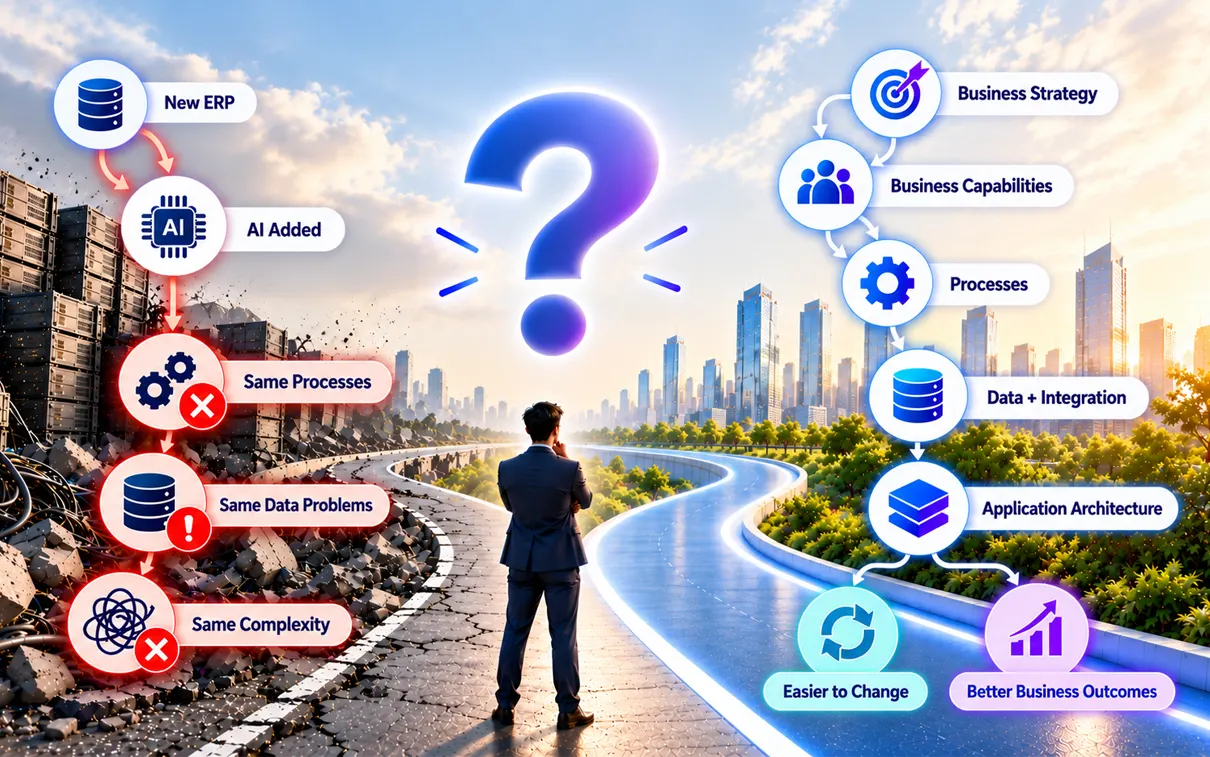
Executive Summary: What Are Digital Platforms?
A digital platform brings together applications, data, and services to increase efficiency, and deliver better experiences through products, services, and connected business operations. These are in place for supporting functions and to help organizations build enterprise-wide capabilities that drive agility, scalability, and innovation. AI and modern technology needs have made it clear that disconnected systems slow innovation, growth, and business adaptability. As a result, executives want Digital Platforms to function as business operating models that unify data, processes, governance, and technology. Aligning platform strategy with Enterprise Architecture supports digital platform development, providing sustainable growth, faster decision-making, and continuous transformation.
Why Are CIOs Asking This Question
Introducing new capabilities quickly while maintaining consistent operational efficiency effectively supports business growth. Traditional application landscapes that are built through years of independent technology investments create disconnected systems, duplicated data, and inconsistent customer experiences. This slows business agility and innovation.
Disconnected technology makes it hard for organizations to update old systems, use AI, and operate across hybrid environments. Achieving these goals becomes difficult when technology is fragmented across the organization. CIOs need a strong technology foundation through digital platform services and Digital Platforms to connect systems, data, and business capabilities into a unified enterprise. Instead of managing disconnected applications, IT leaders are building unified platforms where all company tools, data, and rules work together smoothly.
The question is now about designing Digital Platforms that support long-term business strategy rather than short-term technology needs.
Executive Insight: Digital Leadership Is Becoming a Business Responsibility
Organizations that lead digital transformation no longer measure success by the number of applications they deploy. They measure success by how effectively their enterprise capabilities work together. Digital Platforms provide the operating foundation that connects business strategy, Enterprise Architecture, governance, data, applications, and AI into a unified ecosystem. By shifting from isolated technology projects to reusable enterprise capabilities, organizations reduce complexity, accelerate innovation, and build a foundation for sustainable business growth.
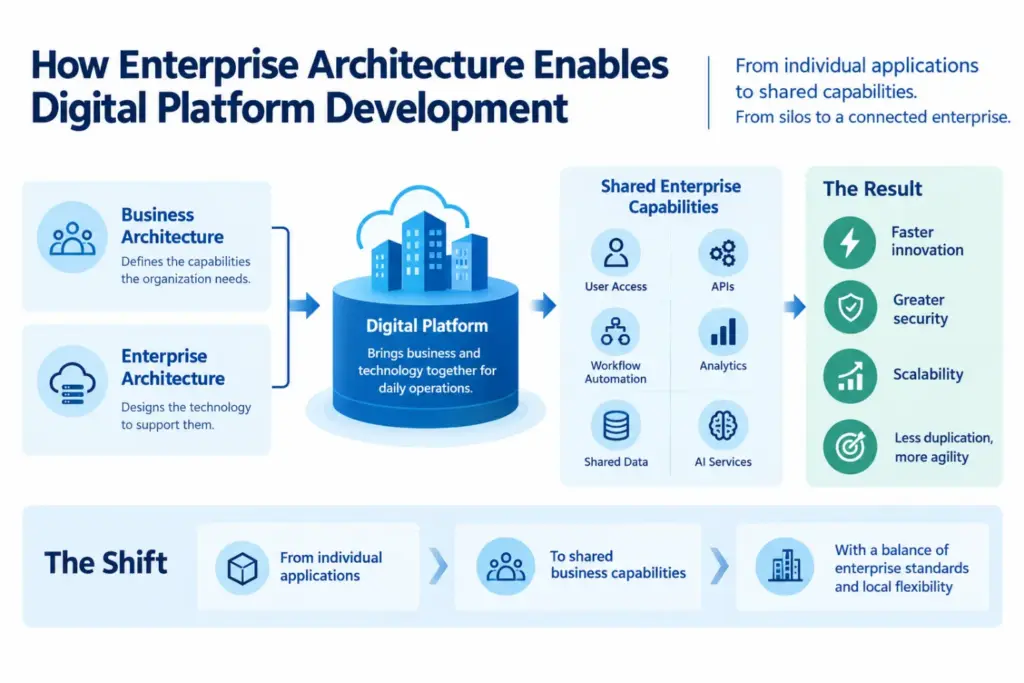
How Enterprise Architecture Enables Digital Platform Development
From an enterprise leadership perspective, a digital platform is defined through organization delivery, integration, and consistent operations across the enterprise. It provides reusable capabilities that teams across the organization can share. This helps launch strategic initiatives faster without duplicating IT efforts while supporting effective digital platform development across the enterprise.
A digital platform requires both Business Architecture and Enterprise Architecture. Where Business Architecture defines the capabilities the organization needs, Enterprise Architecture designs the technology needed to support them. The digital platform brings both capabilities into daily business operations across the enterprise.
Organizations shift technology investments from individual applications to shared enterprise capabilities such as user access, APIs, workflow automation, analytics, shared data, and AI services. They balance enterprise standards with business flexibility to support innovation while keeping systems secure and connected. This approach reduces outdated technology and creates a more agile, scalable enterprise.
Enterprise technology investments are shifting from individual applications to shared business capabilities. This provides a balanced corporate standard with local flexibility to drive innovation while avoiding duplicated, disorganized IT.
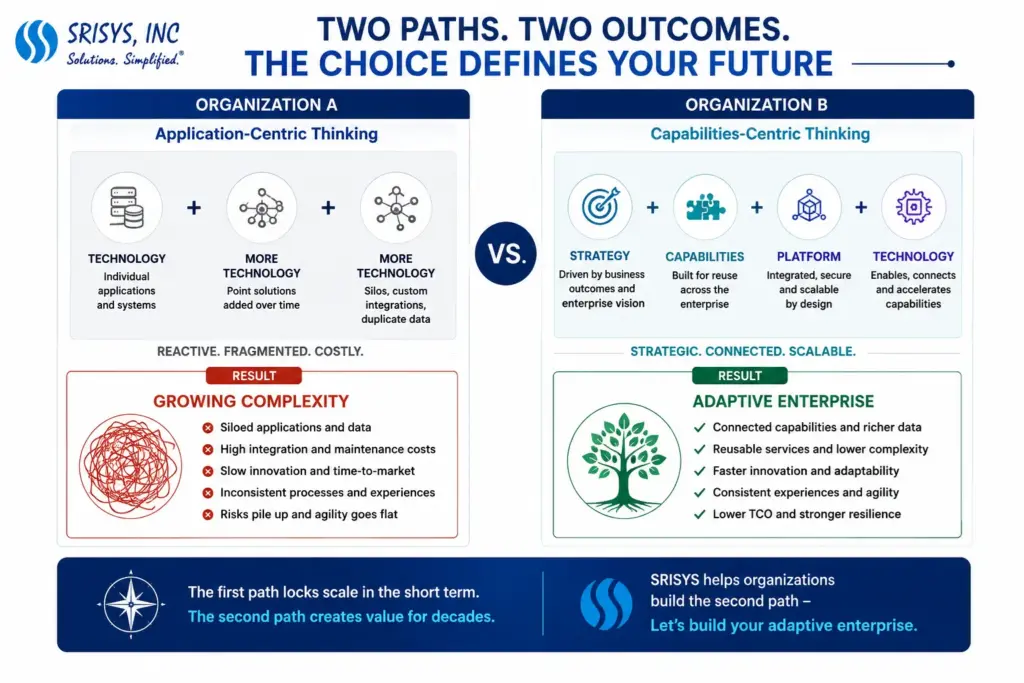
Application-Centric vs Platform-Centric Enterprise
| Traditional Application-Centric IT | Capability-Centric Digital Platform |
| Standalone applications | Shared enterprise capabilities |
| Point-to-point integrations | API-driven integration |
| Duplicate data | Shared enterprise data |
| Independent upgrades | Reusable platform services |
| Higher maintenance costs | Lower operational complexity |
| Slower innovation | Faster business innovation |
| Difficult AI adoption | AI-ready enterprise foundation |
Benefits of Digital Platforms for Business Growth
Digital platform services reduce development effort by providing shared business services that accelerate innovation and enterprise modernization. As a result, organizations can introduce new products, services, and digital experiences faster while also supporting strategic business goals.
Financially, platform-based operating models improve technology investment efficiency. Digital Platforms allow organizations to reuse applications, integrations, and data services across the enterprise, improving efficiency, and increasing return on technology investments.
Operationally, the platform provides consistency in the workflow process throughout the departments, where employees are able to share information and make better decisions. Customers also benefit from more consistent experiences because business functions use shared data and standardized services.
From a technology sustainability perspective, Digital Platforms reduce technical debt by replacing point-to-point integrations with enterprise services. This creates a more connected and manageable technology environment. As a result, organizations can modernize systems gradually instead of relying on large-scale replacement programs.
Overall, organizational agility also increases through Digital Platforms. A modular, reusable digital platform helps organizations adapt quickly to business changes without rebuilding or redesigning core technology.
Most importantly, Digital Platforms provide the governance needed for responsible AI adoption. AI delivers sustainable value through trusted data, standardized processes, and secure integration services.
Strategic Framework for Successful Digital Platforms
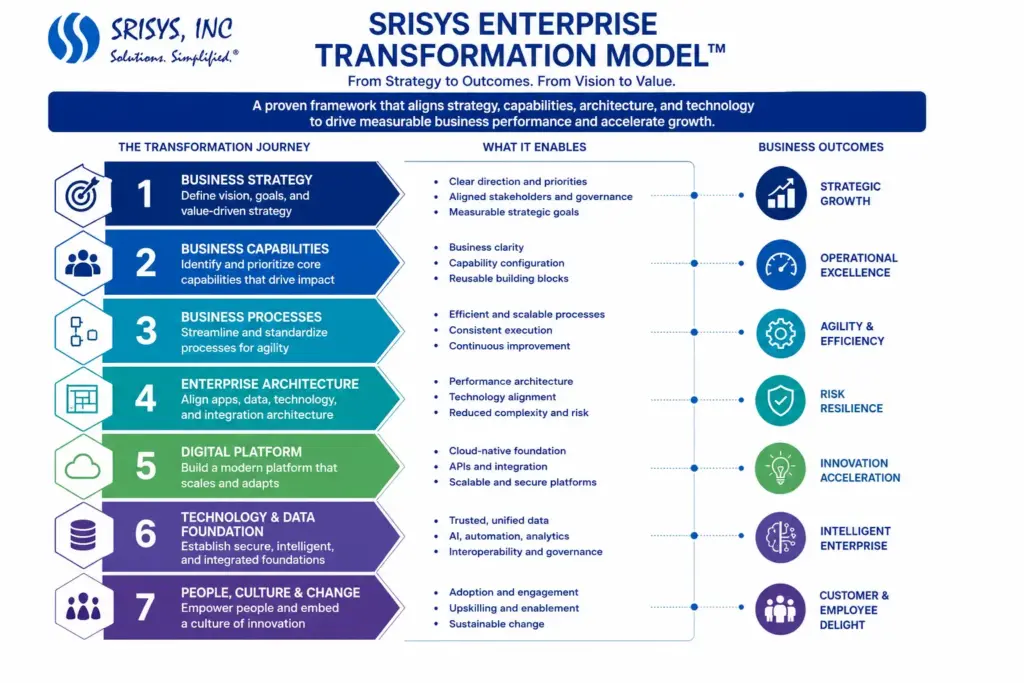
The SRISYS Business-First Application Modernization Framework™ provides an eight-stage approach for connecting application decisions to business strategy, architecture, execution, and measurable outcomes.
Business Strategy
Defined through the organization’s long-term objectives, growth priorities, and business direction. Organizations should make platform decisions based on business strategy, not technology preferences.
Business Capability
Identifies the business capabilities needed to achieve strategic goals, including customer, supply chain, finance, and workforce capabilities.
Business Process
Designs how business capabilities operate consistently while remaining flexible to meet changing business needs.
Enterprise Architecture
Aligns business capabilities with applications, data, integration, security, and technology for a unified enterprise operating model.
Application Portfolio
Evaluates enterprise applications to modernize, integrate, consolidate, retain, or retire based on business and architectural value.
Technology Architecture
Selects technologies, integration, security, and data architecture to support enterprise capabilities securely and reliably.
Implementation Roadmap
Enterprise Architecture prioritizes modernization based on business needs, organizational preparedness, available investment, connected systems, and expected business outcomes, and not just through technology.
Business Outcomes
Tracks business value by measuring agility, efficiency, customer experience, innovation, governance effectiveness, and long-term stability.
Common Executive Misconceptions
Misconception
A digital platform is simply another enterprise software product.
Reality
A digital platform is a reusable business foundation for integrating applications, data, processes, governance, and technology across the enterprise.
Misconception
Cloud migration automatically creates a digital platform.
Reality
Cloud infrastructure provides deployment flexibility, but a digital platform connects applications, data, processes, and governance through a common architecture and shared business services.
Misconception
Every business unit should have its own platform for greater flexibility.
Reality
Enterprise-wide platforms provide shared capabilities and common standards that address their unique needs. This prevents duplicated systems, disconnected data, and technical debt.
Misconception
Platform initiatives primarily belong to the IT organization.
Reality
Successful platforms require joint governance by business leaders, Enterprise Architecture, operations, and technology teams to drive business transformation.
Building Enterprise Digital Solutions for Long-Term Success
Organizations that achieve lasting transformation treat Digital Platforms as long-term business capabilities, not as one-time technology projects. Their investment decisions are guided by business priorities, digital platforms Enterprise Architecture, and governance models that evolve with organizational strategy.
As a response to evolving business needs, organizations add new applications and systems. However, this can lead to duplicate capabilities, disconnected systems, and fragmented data ownership. To effectively address these challenges, modernization efforts should focus on building integrated platforms instead of improving individual systems. This approach simplifies technology, improves consistency, and enhances business agility.
The same applies to AI. Organizations often expect AI to solve business problems immediately. However, with well-organized data, connected systems, common business services, and clear business processes, organizations can adopt AI faster and achieve better results because AI can access reliable information and work across the entire enterprise.
CIO Considerations
- Define digital platform strategy as a business capability initiative, not a technology procurement exercise.
- Align platform investments with Enterprise Architecture, business capability mapping, and operating model objectives.
- Rationalize your application portfolio first and then add new platform capabilities.
- Establish governance to promote innovation and maintain enterprise standards for data, integration, security, and architecture.
- Sequence modernization is based on business value, organizational readiness, and capability dependencies rather than application age alone.
- AI strategies must be grounded in enterprise data, integrated through services, and standardized processes.
- Develop platform capabilities incrementally through measurable business outcomes instead of large-scale technology replacement programs.
Executive Perspective
Digital Platforms support continuous transformation by connecting business goals, technology, data, and processes in a simple way. These connections are the foundations for creating flexible technology environments that adapt to changing business strategies. Bringing together business capabilities, Enterprise Architecture, governance, data, and technology is the right direction towards sustainable transformation. It also helps organizations avoid repeated rebuilding systems.
Organizations create most value from independent modernization projects to develop reusable, governed enterprise capabilities. Sustainable growth is achieved when business direction, Enterprise Architecture, and governance are aligned. This makes Digital Platforms a powerful instrument for innovation and resilience for business in the long term.
SRISYS Point of View
At SRISYS, Digital Platforms are viewed as enterprise capabilities rather than technology solutions. To maximize value, businesses must align Digital Platforms with core strengths and strategic goals. This drives continuous improvement and delivers optimal digital transformation results.
SRISYS believes that Digital Platforms can generate the highest ROI for organizations if these are treated as long-lasting assets of organizations rather than treating them as isolated IT projects. Organizations achieve this when business strategy, organizational structure, decision-making, and performance goals work together.
Our approach focuses on helping organizations:
- Align digital platform investments with business goals and Enterprise Architecture.
- Modernize applications through a phased, business-focused roadmap.
- Build secure, scalable integration and data platforms that support the entire organization.
- Establish governance that encourages innovation while maintaining security, consistency, and compliance.
- Create AI-ready digital foundations with trusted data, standardized business processes, and connected enterprise systems.
For over 20 years, SRISYS has been helping companies update their systems through comprehensive digital transformation services. We have seen businesses do their best when their digital systems and overall plans grow together. When companies use new technology like cloud storage, business applications, data analysis, artificial intelligence, and integration services all together, they prepare themselves for long-term success better than if they just worked on one project at a time. This way, they can build a strong base for their company to keep growing.
Businesses, architects, and tech teams work together towards a common goal to create a strong foundation for their company. This teamwork builds connected systems that support long-term growth and innovation.
When business leaders, Enterprise Architects, and technology teams work toward shared objectives, Digital Platforms become the foundation for continuous innovation and long-term business growth.
Key Takeaways
- Digital Platforms create reusable business capabilities rather than isolated technology solutions.
- Enterprise Architecture ensures platform investments remain aligned with business strategy and operating models.
- Platform governance improves innovation by establishing consistent standards without restricting business flexibility.
- The sustainable use of AI requires solid Digital Platforms, reliable data, and enterprise capabilities.
- Business growth is attained through platform modernization driven by business results rather than technology cycles.
Part 3 of 3 in Enterprise Operations and Managed Services