

An Executive Guide to Building Intelligent, Automated, and Future-Ready Enterprises
Executive Summary
Artificial Intelligence (AI) and Automation are transforming how enterprises operate by improving decision-making, streamlining operations, increasing productivity, and enabling new business capabilities. While automation executes repetitive processes with consistency, AI introduces intelligence that analyzes information, identifies patterns, predicts outcomes, and supports complex business decisions.
Enterprise AI and Automation are no longer isolated technology initiatives. They have become strategic business capabilities that influence every aspect of the organization, from customer engagement and finance to supply chain operations, workforce productivity, and executive decision-making.
Successful adoption requires much more than deploying intelligent software. Organizations achieve sustainable business value only when AI and Automation are aligned with business strategy, Enterprise Architecture, governance, trusted data, security, and modern operating models.
Executive Insight
The enterprise AI conversation is shifting from experimentation to execution. Executive leaders are no longer asking whether Artificial Intelligence and Automation can create value; they are determining where these capabilities should be applied, how they should be governed, and what enterprise foundations are required to scale them responsibly. The organizations most likely to achieve sustainable value are not necessarily those deploying the most AI technologies. They are the organizations that connect AI investments to clear business priorities, measurable outcomes, trusted data, Enterprise Architecture, and effective governance
This creates an important leadership distinction: AI and Automation should not be measured by how much technology an organization deploys, but by how effectively intelligent capabilities improve business performance. For CEOs, CIOs, CTOs, and Digital Transformation Leaders, the strategic priority is therefore to build an enterprise capable of continuously applying intelligence, automation, and data-driven decision-making across changing business needs.
AI and Automation Are Different, and More Powerful Together
Artificial Intelligence and Automation solve different parts of the enterprise problem. Automation executes repeatable tasks and workflows consistently. Artificial Intelligence analyzes information, identifies patterns, generates insights, predicts outcomes, and supports decisions.
The greatest enterprise value often emerges when the two work together: AI helps determine what should happen, while automation helps execute the appropriate action within governed business processes.
| Capability | Artificial Intelligence | Automation |
| Analyze information | ✓ | |
| Identify patterns | ✓ | |
| Predict outcomes | ✓ | |
| Recommend actions | ✓ | |
| Execute repeatable workflows | ✓ | |
| Trigger business processes | ✓ | |
| Human + system orchestration | ✓ | ✓ |
Why Artificial Intelligence & Automation Matter for Business Value
Artificial Intelligence and Automation matter because they fundamentally improve how enterprises create, deliver, and measure business value.
Organizations are expected to operate faster while simultaneously improving customer experiences, reducing operational costs, strengthening compliance, and making better business decisions. AI and Automation enable these outcomes by combining intelligent decision support with automated execution across enterprise operations.
However, technology alone rarely creates transformation. Many organizations continue to struggle because AI initiatives are introduced into environments characterized by fragmented applications, disconnected business processes, inconsistent enterprise data, and outdated integration platforms. These limitations reduce AI effectiveness regardless of the sophistication of the underlying technology.
As AI adoption accelerates, CIOs face increasing responsibility for ensuring intelligent automation aligns with business strategy while maintaining governance, security, compliance, and enterprise scalability.
The objective is not simply to automate work. The objective is to redesign enterprise capabilities that continuously improve business performance.
What AI + Automation Looks Like in Enterprise Operations
Finance: AI identifies anomalies, predicts cash-flow risks, or prioritizes exceptions; automation routes approvals, initiates follow-up, and updates downstream systems.
Customer Service: AI understands intent, summarizes context, and recommends responses; automation routes cases, updates CRM records, triggers notifications, and manages follow-up workflows.
Operations: AI predicts equipment or process risk; automation schedules actions, alerts teams, initiates maintenance, or escalates exceptions according to defined business rules.
Executive Reality: Artificial Intelligence, Automation & Enterprise Architecture
Enterprise Architecture transforms Artificial Intelligence from isolated technology projects into coordinated enterprise capabilities.
It provides the structure needed to integrate AI across applications, business processes, enterprise data, security, cloud platforms, and governance while maintaining consistency across the organization.
Without Enterprise Architecture, organizations often introduce multiple AI tools that duplicate capabilities, increase integration complexity, and create inconsistent governance.
When AI initiatives are guided by Enterprise Architecture, organizations establish reusable services, standardized integration, shared governance, and scalable operating models that support long-term modernization rather than short-term automation.
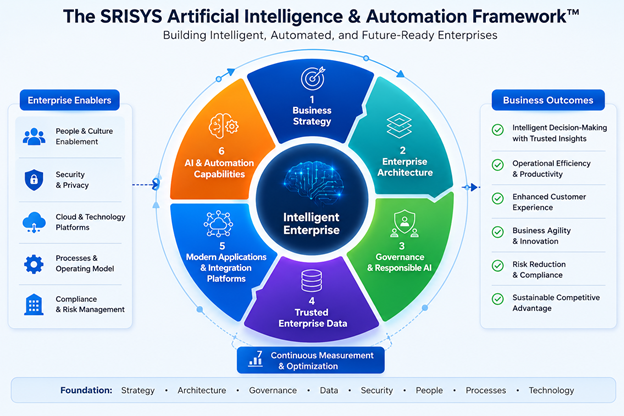
The SRISYS Artificial Intelligence & Automation Framework™
The framework follows a simple sequence: start with business priorities. Use Enterprise Architecture to define how AI and automation connect with applications, data, security, cloud platforms, and business processes. Establish governance and trusted data before scaling. Modernize applications and integration so intelligent capabilities can operate across the enterprise. Then deploy AI and Automation selectively and measure them through business outcomes.
Trusted enterprise data requires more than centralized storage. Organizations need clear ownership, data-quality standards, metadata, lineage, access controls, and consistent definitions for critical business entities such as customers, suppliers, products, employees, and assets. Depending on the operating model, this may involve capabilities such as Master Data Management (MDM), data catalogs, governed data products, lakehouse architectures, or domain-oriented data architectures. The objective is not to adopt a particular data architecture; it is to ensure AI systems operate on trusted, governed, and contextually accurate enterprise information.
Benefits of Artificial Intelligence & Automation
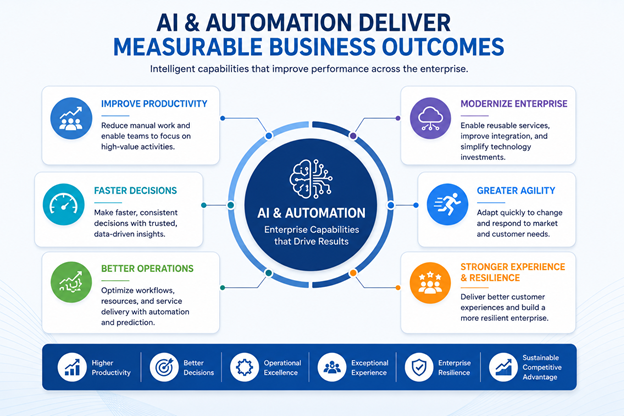
When implemented as enterprise capabilities, Artificial Intelligence and Automation deliver measurable business outcomes across the organization.
Organizations improve productivity by reducing manual effort and enabling employees to focus on strategic, customer-facing, and analytical activities. Decision-making becomes faster and more consistent through intelligent insights generated from trusted enterprise data.
Operational performance improves as standardized workflows, predictive capabilities, and intelligent automation reduce process delays, optimize resource utilization, and strengthen service delivery. AI also supports long-term enterprise modernization by enabling reusable intelligent services, improving application interoperability, and simplifying future technology investments.
Together, these capabilities help organizations increase business agility, strengthen resilience, improve customer experiences, and create sustainable competitive advantages.
How Executives Should Measure AI & Automation
The goal is not to measure how many AI tools or automated workflows have been deployed. The goal is to measure whether enterprise performance improved.
| Measurement Area | Potential KPI |
| Process efficiency | Cycle-time reduction; manual effort eliminated; exception-handling time |
| Decision quality | Decision turnaround time; forecast accuracy |
| Operational performance | Cost per transaction; defect or error rate; downtime or process interruption |
| Customer experience | Response time; resolution time; satisfaction or engagement measures |
| Workforce productivity | Time redirected to higher-value work; employee productivity measures |
| Automation quality | Percentage of automated workflows requiring human intervention or rework |
Executive Considerations
- Business priorities clearly define where AI will deliver measurable value.
- Enterprise Architecture supports scalable integration across applications, data, and business processes.
- Governance establishes accountability for security, compliance, privacy, and responsible AI.
- Enterprise data is trusted, accessible, and suitable for intelligent decision-making.
- Technology investments support long-term modernization rather than isolated departmental automation.
- Success is measured using business outcomes, operational performance, customer experience, and organizational agility.
Illustrative Enterprise Scenario: Intelligent Invoice Processing
Consider a multi-entity enterprise processing thousands of supplier invoices across business units. Invoices arrive through email, supplier portals, PDFs, and other channels. Finance teams spend significant time extracting information, validating purchase orders, identifying discrepancies, routing approvals, and following up on exceptions.
Traditional workflow automation can route invoices, but it struggles when documents, exceptions, and business rules vary. The opportunity is not simply to automate invoice processing. It is to combine AI-driven understanding and decision support with governed workflow automation.
How AI and Automation Work Together
- AI can extract and classify invoice information, match supplier and purchase-order data, identify unusual amounts or duplicate invoices, detect patterns associated with exceptions, and recommend the appropriate processing path.
- Automation can validate information against ERP and procurement systems, route approvals based on business rules, trigger exception workflows, update invoice status, notify appropriate employees or suppliers, and record actions for audit and compliance.
- Human review remains in the process for exceptions, higher-risk transactions, or decisions requiring judgment.
Enterprise Foundations Required
Trusted Data: Consistent supplier, purchase-order, chart-of-account, and organizational data.
Integration: Connections among ERP, procurement, document management, workflow, and financial systems.
Governance: Clear approval authority, AI decision boundaries, auditability, security, and exception-management policies.
Enterprise Architecture: Reusable integration and intelligent services rather than another isolated finance application.
Automation: Governed workflows that execute approved business rules and escalate exceptions appropriately.
What Executives Measure-
| Business Objective | Potential Measure |
| Faster processing | Invoice cycle time |
| Less manual work | Manual touches per invoice |
| Better accuracy | Exception and error rate |
| Greater automation | Straight-through processing rate |
| Better controls | Duplicate and anomaly detection rate |
| Faster resolution | Exception-resolution time |
| Financial efficiency | Cost per invoice |
The value does not come from AI alone or automation alone. It comes from redesigning the business process so intelligence, workflow, enterprise data, integration, governance, and human judgment work together.
Executive Self-Assessment
Executive leaders can evaluate their organization’s readiness by asking:
- Are AI and Automation initiatives aligned with clearly defined business objectives?
- Does Enterprise Architecture support enterprise-wide intelligent automation?
- Are enterprise data quality, governance, and integration mature enough for AI?
- Does governance define accountability for AI decisions, compliance, security, and ethics?
- Are AI investments prioritized according to enterprise business value?
- Do enterprise applications support scalable automation?
- Are AI capabilities implemented as reusable enterprise services?
- Does intelligent automation improve enterprise capabilities rather than isolated departmental efficiency?
Organizations answering “Yes” to most of these questions are significantly better positioned to scale AI while reducing risk and maximizing long-term business value.
Executive Experience
Across enterprise modernization initiatives, one pattern consistently emerges: organizations rarely struggle because AI technology is unavailable. They struggle because enterprise foundations have not evolved at the same pace.
Legacy applications, fragmented business processes, inconsistent data, and decentralized governance often limit the value AI can deliver, regardless of the sophistication of the underlying models.
Organizations that achieve sustainable success typically invest first in strengthening enterprise capabilities, then scale AI through standardized architecture, trusted data, and governance. This disciplined approach enables intelligent automation to deliver measurable business value while remaining adaptable as business priorities evolve.
Common Challenges and Executive Misconceptions
| Common Misconception | Executive Reality |
| AI automatically delivers business transformation. | AI accelerates transformation only when supported by business strategy, Enterprise Architecture, trusted data, governance, and organizational readiness. |
| Automation primarily replaces employees. | Intelligent automation augments human capabilities by improving productivity and enabling employees to focus on higher-value work. |
| The best AI platform is the best place to begin. | Successful adoption begins with business priorities, architecture, governance, and enterprise readiness before technology selection. |
| Every business process should be automated. | Automation delivers the greatest value when applied selectively to standardized, measurable, high-value enterprise processes. |
| AI governance slows innovation. | Effective governance enables organizations to innovate responsibly while reducing operational, regulatory, and business risks. |
SRISYS Executive Recommendation
Organizations should adopt Artificial Intelligence and Automation as strategic enterprise capabilities rather than standalone technology initiatives. Successful implementation requires business strategy, Enterprise Architecture, trusted data, governance, modern applications, integration, and security to evolve together.
A practical approach is built upon four foundational principles:
Establish Governance Before Scaling: Define enterprise policies for responsible AI, security, compliance, privacy, accountability, and model oversight before expanding automation.
Prioritize Business Capabilities: Invest in AI initiatives that improve measurable business outcomes rather than following technology trends or isolated departmental requests.
Modernize Enterprise Foundations: Strengthen enterprise data, applications, cloud platforms, integration architecture, and operating models before deploying intelligent automation at scale.
Embed AI into Enterprise Architecture: Treat Artificial Intelligence as a permanent enterprise capability that continuously evolves alongside business strategy, organizational priorities, and enterprise modernization.
With more than 20 years of experience in Enterprise Architecture, enterprise modernization, cloud platforms, ERP ecosystems, data strategy, integration, and Artificial Intelligence, SRISYS has consistently observed that organizations achieve the greatest long-term business value when they strengthen enterprise foundations before scaling AI and Automation.
Key Takeaways
- Business strategy should guide Artificial Intelligence and Automation investments.
- Enterprise Architecture provides the integration and governance foundation for scalable AI adoption.
- Trusted data, modern applications, and enterprise integration determine AI success more than algorithm sophistication.
- AI and Automation should strengthen enterprise capabilities rather than create isolated technology projects.
- Sustainable transformation aligns business strategy, governance, people, processes, data, and technology.
- Executive leaders should measure AI success through business outcomes, organizational agility, and long-term enterprise capability, not technology deployment alone.
Part 2 of 2 in AI Strategy & Business Transformation