
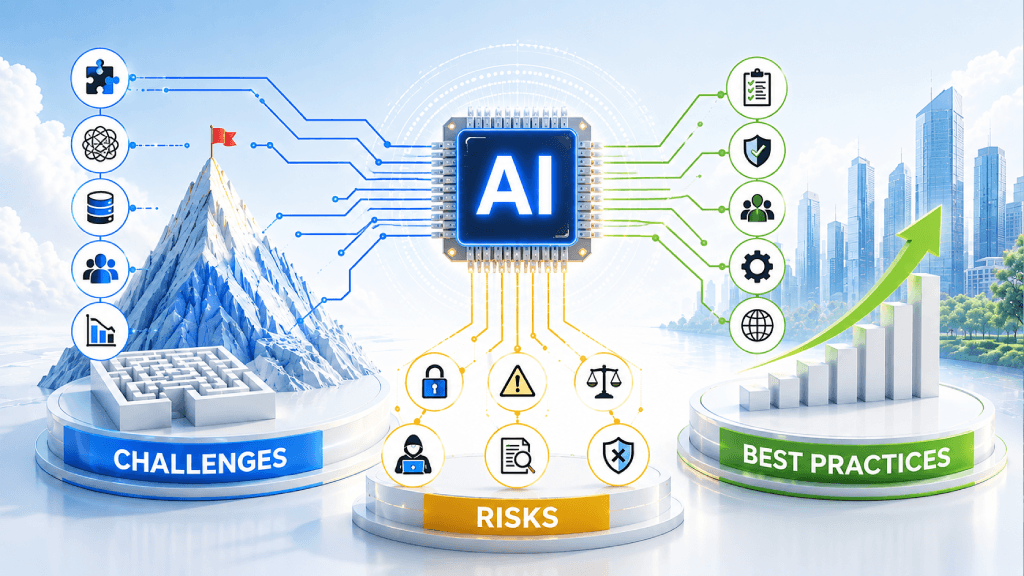
An Executive Guide to Building Enterprise AI Readiness, Governance, and Sustainable Business Value
Organizations achieve Enterprise AI success by building the governance, data, architecture, and business capabilities that enable AI to create sustainable business value.
Executive Summary
Enterprise Artificial Intelligence adoption is strategically integrating Artificial Intelligence into all business functions, technology, and enterprise operations. AI deployment direct impacts efficiency, and customer experience. However, to successfully AI adoption, strategy alignment, data governance, and a solid organizational structure are essential to driving real business value.
Executive Insight
Enterprise AI adoption is now a leadership priority than just a technology initiative. Effective business strategy, governance, Enterprise Architecture, and trusted data have a powerful impact on creating long-term value long before you choose your tech. AI integration into core enterprise capabilities makes scaling safer, improves decisions, lowers risks, and provides measurable results with better agility.
Why Strategic AI Matters for Business Value
Strategic AI matters because business organizations can create measurable business value and not just implement automation. The Enterprise AI journey has moved from Innovation Labs to the Boardroom. As business leaders expect AI to increase productivity, help in better decisions, change the way customers interact with organizations, and increase operational efficiency, the more important question today is how to adopt and implement AI across the entire Enterprise without increasing complexity, risk or technical debt.
There exist legacy systems, fragmented data, and applications, whose design does not support AI. This is why modernization of data platforms, the application portfolio, and integration architecture is often cited as a side effect of successful use of AI in an enterprise.
Regulatory expectations regarding privacy, security, explainability, and responsible use of AI are continually evolving. As a result, the CIO has a significant challenge in ensuring that the organization can harness the power of AI while also delivering value to the business, managing risk, and supporting the long-term operating model of the organization.
AI is about more than adopting technology. As a leader, you need to ensure that your Enterprise AI adoption is aligned with your business strategy, your Enterprise Architecture, your data, your people, your security and your technology.
Executive Reality: Enterprise AI Adoption and Enterprise Architecture
When starting to adopt AI, companies first must identify business capabilities that can be improved by better decisions, automated processes, and by using predictive intelligence. Selecting technology first and then trying to make it work for the business is one of the main reasons why companies cannot create enough business value with their AI investments.
Architecture for AI can only be adequate if it is integrated with Enterprise Architecture. Architecture for AI needs to ensure integration with Business Processes and Applications as well as with Data Platforms, Security as well as with Governance Models.
Instead of building additional systems of their own, AI should support the core functions of finance, customer care, and other operations to improve overall business performance.
Therefore, AI needs to be treated as a long-lasting enterprise capability that is supported by appropriate governance, a reusable platform, and standardized integration into the various applications of an enterprise. The primary aim of implementing AI should be to improve the core functions of an enterprise, such as finance and customer service, as well as its processes and decision-making capabilities.
The SRISYS Enterprise AI Adoption Framework™
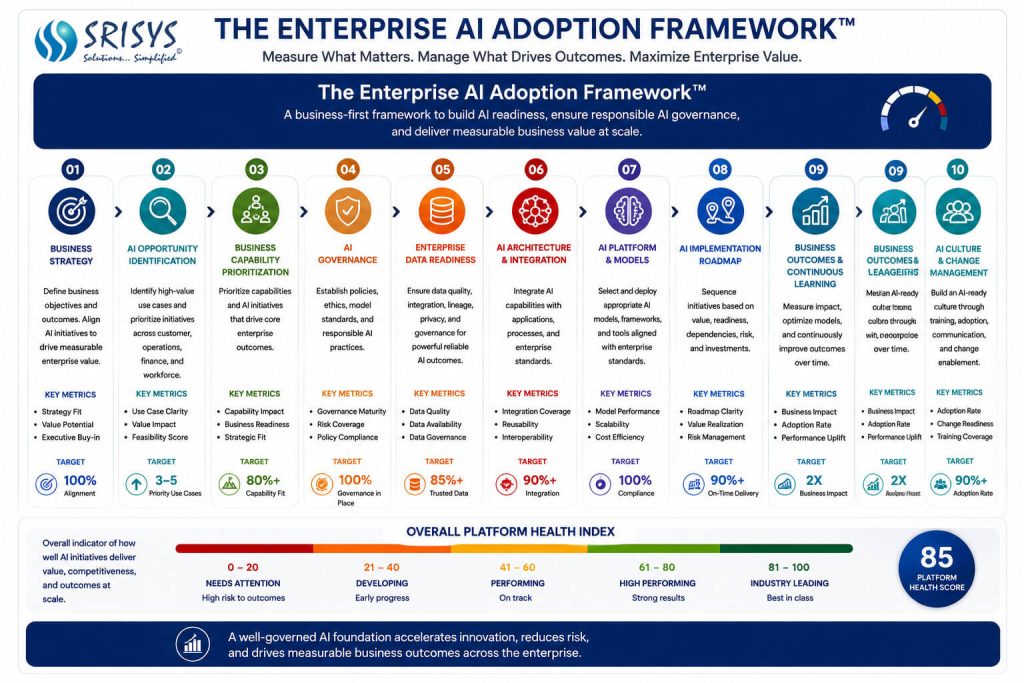
Understanding the Framework
The SRISYS Enterprise AI Adoption Framework™ helps companies use Artificial Intelligence as a part of their business instead of isolated projects. From business strategy to governance, Enterprise Architecture, trusted data, and modern technology platforms, our structured approach enables organizations to scale AI responsibly. Other benefits include lower implementation risks, better decisions, stronger business value while maintaining security, compliance, and agility.
Benefits of Enterprise AI Adoption
Business value is created when AI improves enterprise-wide business capabilities, rather than automating individual tasks. As AI gets embedded into business processes, manual work can be reduced, better forecasting can be developed, faster decisions can be taken, and more customer responsive services can be delivered.
AI Implementation in a disciplined manner enables stronger financial performance in organizations. When AI initiatives align with enterprise priorities, they improve productivity, optimize resource allocation, reduce operational inefficiencies, and create sustainable business value. On the other hand, investment in disconnected systems increases software costs, duplicate capabilities, and increase maintenance burdens
Looking from a technology perspective, enterprise-wide AI encourages modernization of data platforms, application portfolios, and integration architectures. Such improvements prepare organizations for future technologies while reducing the need to rebuild core systems.
Governance is critical to make sure organizations monitor the data used in AI models, the models themselves, and how AI is used. It helps reduce potential risks and protect the organization. This results in increased trust in AI-assisted decisions and gives executives greater confidence in business outcomes.
Ultimately, enterprise AI makes companies faster, smarter, and better at adapting to changes. It helps them serve customers and reach big goals- all while keeping their systems organized, secure, and under control.
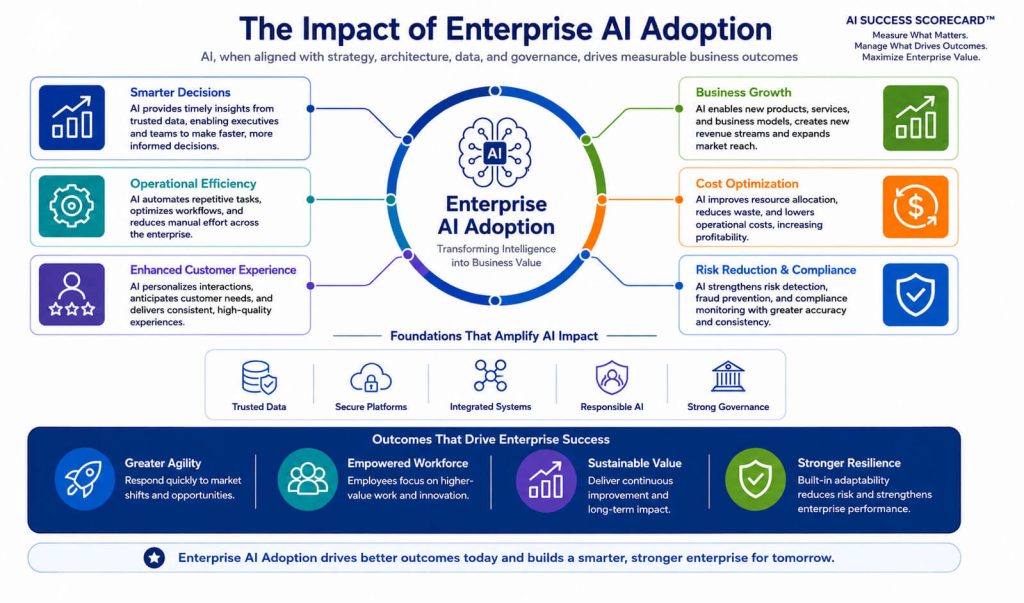
Understanding the Framework
The Enterprise AI Adoption framework shows how Artificial Intelligence can really help businesses when it is used correctly. Enterprise AI Adoption needs trusted data, safe platforms, integrated systems, responsible Artificial Intelligence practices and strong governance to work well.
Collectively, these capabilities improve productivity, organizational agility, resilience, and increase business value. This also means organizations that align AI with business strategy, enterprise architecture, and governance achieve the greatest value.
Executive Considerations
- Define AI as a business capability initiative rather than a standalone technology project.
- Align AI investments with business strategy, Enterprise Architecture, and measurable business outcomes.
- Strengthen data quality, governance, and integration before scaling AI across the enterprise.
- Prioritize AI initiatives based on business value, organizational readiness, and architectural dependencies.
- Modernize applications and integration platforms to support secure, enterprise-wide AI adoption.
- Establish governance that promotes responsible AI while maintaining security, compliance, and transparency.
- Build AI capabilities incrementally through reusable enterprise services instead of isolated pilots.
Executive Boardroom Scenarios
Consider two organizations beginning their Enterprise AI journey.
The first launches AI initiatives across multiple departments as opportunities arise. Marketing uses generative AI; customer service chatbots, finance tests- predictive analytics, and operations- independent machine learning.
Each new project brings some benefits, but over time separate data, inconsistent governance, duplicated investments, and disconnected technologies make it harder to expand AI across the organization.
The first launches AI initiatives across multiple departments as opportunities arise. Marketing uses generative AI; customer service chatbots, finance tests- predictive analytics, and operations- independent machine learning.
The second organization takes a different approach. The leaders begin with clear business goals, team alignment through Enterprise Architecture, and establish governance, trusted data, and integrated systems before launching AI initiatives. This is how safe, scalable, and sustainable AI is adopted.
Five years later, both organizations have invested significantly in Artificial Intelligence.
One has accumulated AI tools.
The other has built an AI-enabled enterprise.
The difference is not the AI technology.
It is the leadership discipline to build enterprise capability before scaling AI.
Executive Self-Assessment
Executive leaders can use the following questions to evaluate their organization’s readiness for Enterprise AI adoption.
- If AI initiatives are aligned with clearly defined business objectives.
- Does Enterprise Architecture supports scalable AI integration across applications and business processes?
- Are data governance, quality, and security mature enough to support trusted AI outcomes?
- Does AI governance define accountability for privacy, compliance, model oversight, and responsible AI practices?
- Are AI investments prioritized according to business value rather than departmental demand?
- Do Modern applications and integration platforms enable secure information sharing across the enterprise?
- Are AI capabilities designed as reusable enterprise services instead of isolated technology projects?
- Does your AI strategy improve business outcomes, organizational agility, and enterprise capabilities?
Organizations that answer “Yes” to most of these questions are in a stronger position to grow AI, reduce risks, and achieve long-term business value.
Executive Experience
CIOs play a key role by establishing Enterprise AI governance before expanding AI across the organization. By defining clear policies for data quality, data security, compliance, and accountability, they create a strong foundation for AI adoption. This helps ensure AI is used securely, consistently, and in alignment with business and regulatory requirements.
Prioritizing AI investments based on business goals is more effective than responding to individual department requests.
Implementing AI in phases based on organizational readiness and technology needs to improve long-term success. Modernizing applications, strengthening system integration, and reducing technical debt support for AI adoption.
Treating data governance as a strategic priority ensures AI uses trusted, consistent, and well-managed business information.
Finally, AI should be incorporated into long-term enterprise architecture planning rather than managed as an independent technology program. This approach enables future scalability while maintaining alignment with evolving business strategies and operating models.
Common Challenges and Executive Misconceptions
| Common Misconception | Executive Reality |
| The most advanced AI platform is the best starting point for AI adoption. | Successful AI adoption begins with business strategy, not technology selection. Organizations should first assess business capabilities, define the target architecture, establish governance, and ensure high-quality data before selecting AI platforms to maximize long-term value. |
| More AI pilots automatically accelerate enterprise transformation. | Multiple disconnected AI pilots often increase complexity and duplicate investments. Scalable AI adoption requires shared governance, a common enterprise architecture, standardized platforms, and organization-wide implementation standards. |
| AI primarily replaces human work. | Enterprise AI is designed to augment, not replace, human capabilities. AI supports better decision-making and automates repetitive tasks, allowing employees to focus on higher-value activities that require judgment, creativity, and strategic thinking. |
| AI governance slows innovation. | Effective AI governance enables responsible innovation. Clear policies, defined accountability, robust security controls, and ethical oversight allow organizations to scale AI confidently while minimizing operational, regulatory, and business risks. |
SRISYS Executive Recommendation
Organizations should approach Enterprise AI as an enterprise capability and not a software initiative. Successful AI adoption depends on business strategy, Enterprise Architecture, strong governance, trusted data, and modern integration working together. When these foundations are in place, organizations can use AI more effectively, reduce risks, and create long-term business value.
A practical approach to Enterprise AI adoption is built on four foundational principles:
- A practical approach to Enterprise AI adoption is built on four foundational principles:
- Prioritize Business Capabilities
Invest in AI that delivers business value instead of following technology trends or requests. - Modernize Data and Integration Foundations
Build trusted data, connected systems, and scalable platforms that give AI secure access to business information. - Embed AI into Enterprise Architecture
AI should be adopted as a long-term plan for the organization, like it evolves alongside business strategy, operating models, and technology.
With more than 20 years of experience in Enterprise Architecture, cloud, integration, ERP modernization, data platforms, and AI adoption, SRISYS has seen that organizations achieve the best outcomes when they strengthen their enterprise foundations before scaling AI initiatives.
Key Takeaways
- Business strategy (Business-first approach) should guide Enterprise AI decisions and implementation.
- Good governance, strong architecture, and quality data enable effective AI scaling.
- AI should improve business capabilities, not create separate technology projects.
- Successful AI adoption requires modern applications, data, integration, and processes.
- Enterprise AI success is measured through better outcomes, agility, and governance.
Part 1 of 2 in AI Strategy & Business Transformation