
Executive Summary
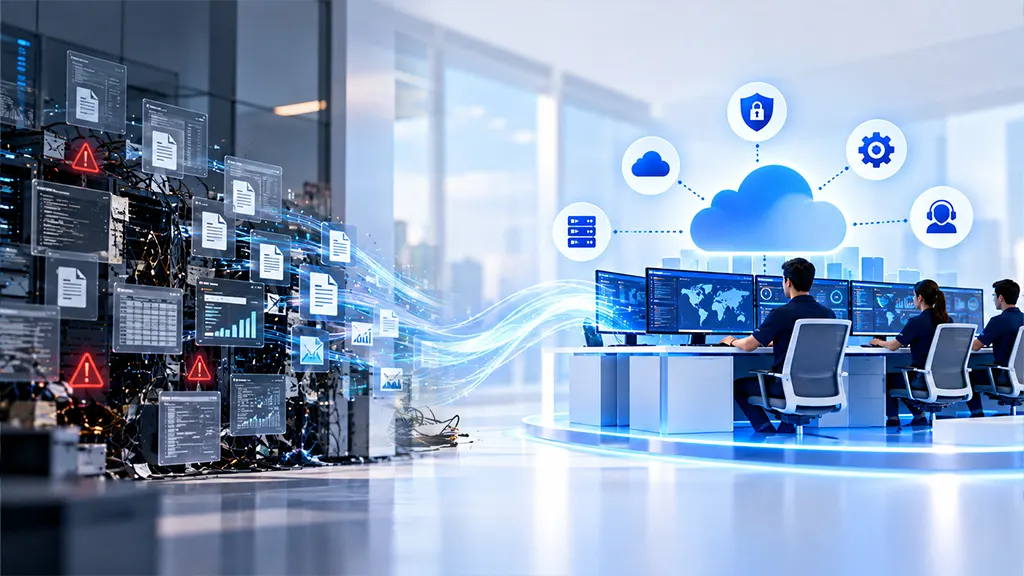
Managed IT Services help organizations manage technology, improve security, support cloud adoption, and drive digital innovation in modern enterprises. The role of Managed IT Services is more than infrastructure monitoring and technical support. These services are employed to improve stability, strengthen governance, use expert knowledge, and support business growth.
Enterprise technology environments are becoming more complex as organizations expand cloud platforms, cybersecurity requirements, enterprise applications, AI capabilities, and digital services. As a result, executives are increasingly evaluating Managed IT Services not simply as a cost-saving measure, but to improve resilience, access specialized expertise, and refocus internal teams on strategic priorities.
This executive briefing helps leaders evaluate Managed IT Services by aligning outsourcing with business strategy, governance, and Enterprise Architecture.
Executive Insight
Managed IT Services do not transfer technology responsibility. They share IT operations, allowing organizations to focus on strategy, growth, innovation, and core strengths.
Business leaders must understand the difference between operational execution and strategic ownership. Specialized providers can efficiently manage day-to-day IT operations. However, the enterprise must retain ownership of business strategy, Enterprise Architecture, governance, technology investments, and operating models.
From an Enterprise Architecture perspective, Managed IT Services have become one component of the broader technology operating model. Service providers support defined operational capabilities, while enterprise architecture establishes standards for applications, integration, security architecture, identity management, cloud strategy, and data governance.
As organizations adopt AI, automation, and cloud-native technologies, they need stronger governance to manage increasing operational complexity effectively and consistently.
Without Enterprise Architecture oversight, outsourcing operations can increase complexity instead of reducing it. However, when organizations align Managed IT Services with a well-defined Enterprise Architecture, they achieve greater consistency, control, and long-term stability.
Executives should decide which IT capabilities to retain, and which specialized partners can manage effectively.
Why Executive Leaders Are Shifting to Managed IT Services
Deloitte’s 2026 Global Technology Leadership Study highlights the growing resource squeeze facing technology leaders. The study notes that, in Deloitte’s 2023 survey, technology executives reported spending 48% of their technology budgets on “run” activities, compared with 31% on “grow” and 21% on “transform”. In 2026, Deloitte reports a shift toward a more balanced distribution as technology leaders are expected to run, change, protect, and grow the business simultaneously. Managed IT Services can help organizations rebalance capacity toward strategic initiatives when applied within a clear operating model.
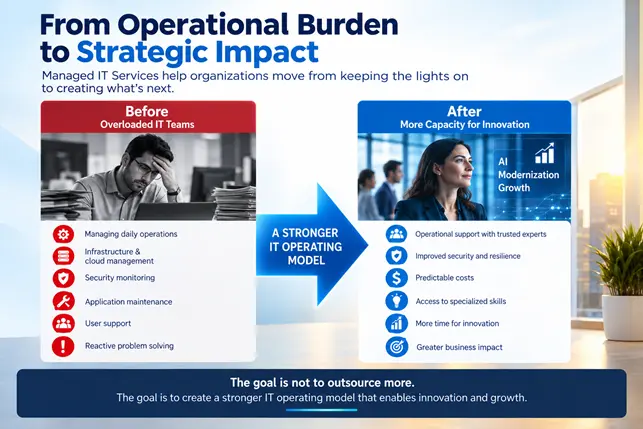
Growing business demands put pressure on internal IT teams. They spend time managing daily operations, leaving less time for innovation and business transformation.
At SRISYS, while providing advisory services for growing organizations, we often find that the problem is not maintaining the infrastructure; it is about the governance of an ever-evolving digital world of cloud computing, ERP applications, and AI frameworks.
Executive Reality: Managed IT Services and Enterprise Operating Models
Managed IT Services are often considered by enterprises once their internal IT groups have become overloaded with increasing operational needs. Infrastructure complexity, cybersecurity requirements, cloud environment, enterprise software, and AI implementation result in an increased need for specific skills.
Outsourcing creates the most value when Managed IT Services are integrated into Enterprise Architecture, cloud strategy, cybersecurity, and business capability planning. Clear governance keeps provider execution aligned with enterprise standards and reduces the risk of adding new operational complexity. Enterprise leaders should retain responsibility for strategy, architecture, governance, security, and technology investments, while managed service providers handle operational execution within clearly defined standards. This balanced operating model strengthens accountability, improves operational efficiency, and enables technology to better support long-term business objectives. The following framework illustrates how Managed IT Services align with enterprise strategy, governance, and business outcomes.
SRISYS Business-First Framework
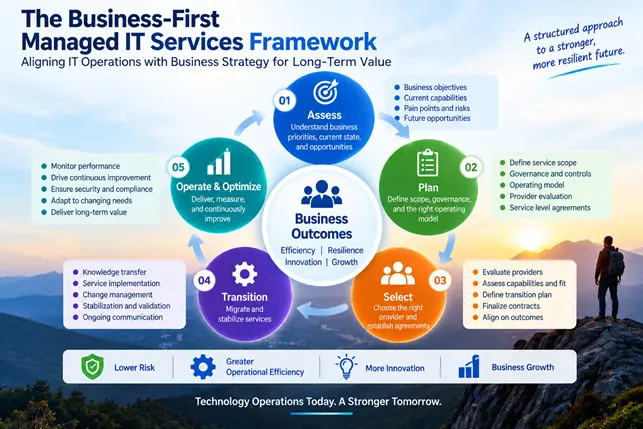
Business-First Managed IT Services Framework: assess, plan, select, transition, and continuously optimize around measurable business outcomes.
Understanding the Framework
The SRISYS Business-First Managed IT Services Framework™ simplifies outsourcing decisions. It connects Managed IT Services with business strategy and long-term goals. It also aligns IT operations with architecture, governance, security, and cloud strategy.
Organizations move through clear stages, starting with business priorities and capability assessment before selecting the right provider and transitioning services. They then focus on efficient operations and continuous improvement. This structured approach improves service quality, reduces risk, builds resilience, and gives internal IT teams more time to drive innovation and business growth.
Business Value Delivered by Managed IT Services
Strategic Managed IT Services shift routine operational work away from internal teams. This allows IT teams to focus on innovation, improving customer experiences, developing better solutions, and supporting long-term business growth.
From a financial perspective, outsourcing selected IT operations helps organizations better predict costs and plan technology investments. Instead of expanding internal teams for every operational need, organizations can use specialized partners and direct internal resources toward areas that create greater strategic value. The advantage is not simply lower cost; it is more deliberate allocation of technology investment and capacity.
For CFOs and CIOs, the evaluation should consider total operating economics rather than labor cost alone. Relevant factors include internal staffing requirements, platform support costs, downtime risk, specialized skill availability, security obligations, modernization needs, and the opportunity cost of internal teams spending time on routine operations instead of strategic initiatives.
Operational efficiency improves through standardized service management, proactive monitoring, automation, and established operational processes. Mature operating practices reduce service disruptions, accelerate issue resolution, and improve overall technology reliability.
Technology sustainability also improves because managed service providers continuously maintain supported platforms, security updates, operational documentation, and lifecycle management practices. This reduces the accumulation of operational technical debt that often results from deferred maintenance.
Clear roles, security, compliance, and performance expectations make Managed IT Services more effective. Strong governance reduces risk while keeping organizations accountable and aligned with business goals. Ultimately, organizations become more agile because internal technology teams spend less time sustaining existing environments and more time enabling business change.
Executive Considerations
Before transitioning operational responsibilities, executive leaders should evaluate the following strategic considerations to ensure outsourcing strengthens enterprise capabilities rather than introducing additional operational complexity.
- Identify which technology strengths support the business strategy and maintain executive control over these key areas.
- Integrate Managed IT Services into business operations instead of treating them as standalone outsourcing.
- Ensure Enterprise Architecture, security architecture, data governance, and integration standards guide provider selection and operational execution.
- Prioritize governance, accountability, and measurable business outcomes before transitioning operational responsibilities.
- Align managed service investments with application modernization, cloud strategy, AI readiness, and long-term portfolio rationalization.
Maintain internal capabilities in business architecture, enterprise governance, vendor management, and strategic technology planning.
Executive Boardroom Scenario: Guided by SRISYS Architects
Recently, a global organization partnered with SRISYS after experiencing severe operational strain on its internal IT teams. Rapid cloud expansion, heightened cybersecurity mandates, and continuous application maintenance had left internal engineering with zero capacity for business innovation.
During an executive review, SRISYS architects addressed a fundamental question:
“Should our technology leaders spend more time maintaining systems or creating future business capabilities?”
The leadership team recognized that operational complexity was limiting strategic progress.
Instead of outsourcing technology completely, the organization created a balanced operating model. Enterprise Architecture defines governance standards, security requirements, integration principles, and ownership boundaries. Managed service partners were then aligned to support operational execution.
Over time, internal technology teams focused more on digital transformation, AI adoption, and business innovation, while operational reliability improved.
The greatest benefit was not outsourcing technology. It was creating an operating model where technology could support business growth more effectively.
Executive Self-Assessment
Executive leaders can use these questions to evaluate their organization’s readiness for Managed IT Services:
- Are outsourcing decisions aligned with business strategy rather than short-term operational challenges?
- Are strategic technology capabilities clearly identified and retained within the organization?
- Does Enterprise Architecture define standards before operational responsibilities are transitioned?
- Are security, compliance, data governance, and integration requirements clearly established?
- Are managed service providers measured through business outcomes rather than only technical service levels?
- Does the organization maintain strong vendor governance and accountability models?
- Are internal technology teams focused on innovation and business capability development?
- Are managed services integrated into the broader enterprise operating model?
Organizations that can confidently answer “Yes” to most of these questions are better positioned to achieve operational resilience while maintaining strategic control.
SRISYS Advisory Experience
Across enterprise modernization engagements, organizations often consider outsourcing only after internal technology teams become overloaded by infrastructure, cloud, security, and application support demands. The stronger approach is to establish governance, service boundaries, and business outcomes before the transition occurs.
Successful Managed IT Services engagements begin with clearly defined business outcomes, not only technical service catalogs. When service boundaries align with business capabilities and Enterprise Architecture, accountability is clearer and governance is more effective. The most effective operating model keeps strategic capabilities – Enterprise Architecture, digital transformation, AI strategy, portfolio management, and business engagement – under internal leadership, while specialized providers execute defined operational services within established standards.
Common Challenges & Executive Misconceptions
| Common Misconception | Executive Reality |
| Managed IT Services are primarily a cost-reduction initiative. | The primary objective is to improve operational capability, scalability, resilience, and executive focus. While cost optimization may be a benefit, the greater value lies in enabling business agility, strengthening service reliability, and supporting long-term transformation. |
| Outsourcing means relinquishing control over technology. | Operational responsibilities can be delegated, but strategic ownership remains internal. Governance, Enterprise Architecture, investment strategy, security, and business accountability should continue to be led by executive leadership. |
| All IT functions should either remain in-house or be fully outsourced. | The most effective operating model is a balanced one. Organizations achieve better outcomes by retaining strategic capabilities internally while selectively outsourcing operational services to specialized providers. |
| A service provider can solve architectural complexity. | Enterprise Architecture – not the service provider – must define standards, integration, governance, and the operating model. Managed IT Services are most effective when they operate within a well-defined architectural and governance framework. |
Executive Reflection
Enterprise technology organizations are entering an era where success depends less on the size of internal IT teams and more on how effectively technology capabilities are organized, governed, and aligned with business priorities.
Managed IT Services should not be viewed as replacing internal expertise. Instead, they should complement internal capabilities by transferring routine operational responsibilities to specialized providers while allowing enterprise technology leaders to focus on innovation, architecture, governance, and strategic business outcomes.
The organizations achieving the greatest value from outsourcing are not those that delegate the most work-they are those that clearly distinguish between operational execution and strategic ownership. When governance remains strong and Enterprise Architecture guides decision-making, Managed IT Services become an enabler of business agility rather than simply an external support function. Ultimately, successful outsourcing is not measured by the number of services transitioned to a provider. It is measured by the organization’s increased ability to innovate, respond to change, and achieve its long-term business objectives.
SRISYS Executive Recommendation
Managed IT Services should be evaluated through the lens of enterprise transformation rather than operational efficiency alone. The objective is not to outsource technology leadership, but to create an operating model that allows technology organizations to dedicate more time to business innovation, architectural evolution, and strategic decision-making.
In our experience, organizations achieve more sustainable outcomes when outsourcing decisions are guided by business strategy, Enterprise Architecture, governance, and operating model design instead of short-term operational pressures. When business priorities, enterprise capabilities, data, people, governance, and technology evolve together, Managed IT Services becomes an enabler of long-term organizational resilience rather than simply another technology sourcing decision.
Key Takeaways
- Managed IT Services are an operating model decision, not simply an outsourcing decision.
- Enterprise Architecture should define governance before operational responsibilities are delegated.
- Internal technology teams should focus on strategic business capabilities while specialized partners support operational execution.
- Effective governance ensures outsourcing strengthens resilience without reducing enterprise accountability.
Sustainable modernization requires balancing business strategy, people, governance, technology, and operational partnerships.
Organizations achieve the greatest long-term value when Managed IT Services are supported by strong governance, Enterprise Architecture, and technology investments aligned with business strategy.
Part 1 of 1 in Enterprise Operations and Managed Services