

How Enterprise Architecture Enables Business Strategy, Governance, and Sustainable Growth
Executive Summary
Enterprise Architecture is a business discipline connecting strategy, business capabilities, processes, data, applications, and technology. It is more than building technology models; it helps executives make better investment, modernization, governance, and risk decisions.
As organizations adopt artificial intelligence, cloud-based solutions, and digital operating models, enterprise architecture consulting can help ensure that technology investments support business objectives and long-term growth.
Enterprise Architecture helps executives make better investment decisions, simplify operations, manage risk, and strengthen governance. A sound Enterprise Architecture also supports smooth integration of enterprise systems, helping critical platforms and data work together efficiently.
Executive Insight
Enterprise Architecture helps leadership translate business strategy into coordinated decisions about capabilities, processes, data, applications, and technology. Its value is greatest when organizations are managing AI adoption, cloud modernization, legacy systems, integration, and competing technology investments.
Executive leaders use Enterprise Architecture to guide technology investments and improve governance. It further supports:
- AI adoption
- Digital transformation
- Long-term business growth
- Enterprise systems integration
- Scalable technology modernization
The goal is not simply to adopt technology faster, but to ensure every major technology investment strengthens the enterprise as a whole.
Why Enterprise Architecture Matters Now
Executive leaders must balance the need to innovate with the need to keep critical systems stable, secure, and reliable. CIOs and CTOs are confronted by the challenge of dealing with various conflicting requirements:
- Responsible AI Adoption: Scaling AI models safely across enterprise workflows.
- Modernization of Cloud and Infrastructure: Replacing outdated legacy systems.
- Consolidation of Portfolio: Combining duplicate SaaS and enterprise software platforms.
- Cybersecurity & Compliance: Securing identity, data, and access across distributed systems.
The Cost of Uncoordinated Modernization-
Without Enterprise Architecture, modernization devolves into a series of disconnected technology projects. Departments implement point solutions independently, resulting in:
- Fragmented Data: Business data silos that make it difficult to analyze the organization.
- Integration Challenges: Point-to-point integration that creates technical debt.
- Rising Costs: Duplication of subscription costs, vendor agreements, and IT expenditures.
- Misalignment of Objectives: Modernization initiatives that do not shift any KPIs for the core business.
Here, enterprise integration solutions take on strategic importance. Integration must be more than connecting systems. It should support business processes, improve data flow, reduce complexity, and make future change easier.
SRISYS Enterprise Architecture Framework
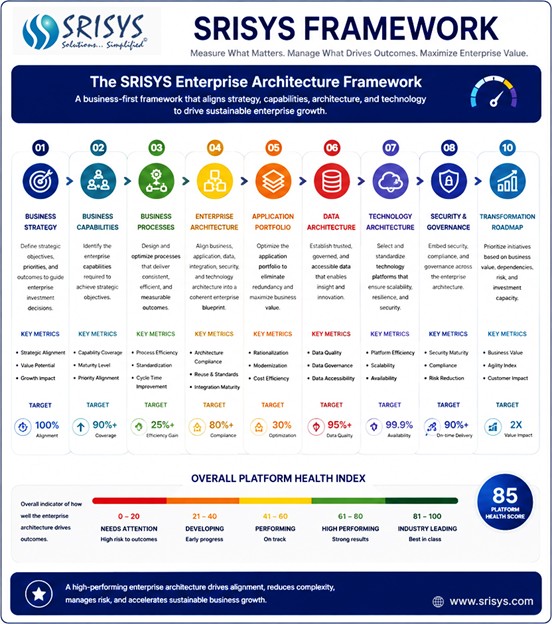
The SRISYS Enterprise Architecture Framework provides a business-centered view for evaluating how strategy, capabilities, processes, applications, data, technology, and governance work together. It gives leadership a common basis for deciding what to modernize, what to integrate, what to simplify, and where investment should be sequenced.
Within this foundation, enterprise integration services help connect applications, data, and processes in ways that support business capabilities rather than creating isolated technical connections. The framework enables organizations to build an agile, scalable, and resilient enterprise that can continuously adapt to changing business priorities and emerging technologies.
Benefits: Business Value & ROI of Enterprise Architecture
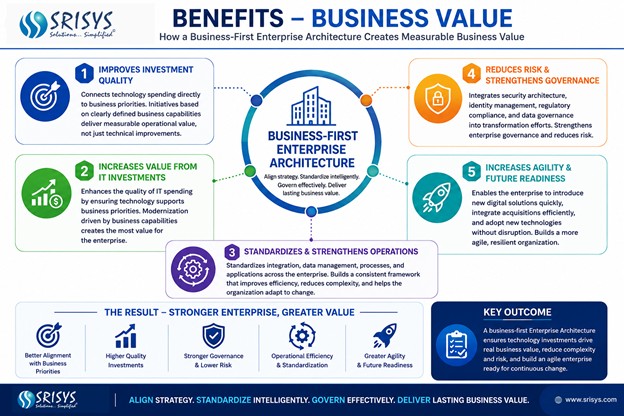
Enterprise Architecture delivers five key business outcomes:
For executives, the value of Enterprise Architecture is measured less by architectural documentation and more by the quality of decisions it enables:
- Better Investment Decisions – Connect technology spending to business priorities and capabilities.
- Lower Complexity – Reduce duplicate applications, integrations, processes, and vendors through coordinated system integration services and modernization planning.
- Stronger Governance – Align security, identity, compliance, and data governance with transformation.
- Reduced Risk – Identify dependencies and architectural risks before major investments are made.
- Greater Agility – Create a flexible foundation for AI, cloud, acquisitions, and future business change.
A well-designed enterprise integration platform can further support this agility by allowing organizations to connect new technologies with existing systems without repeatedly creating custom integration patterns.
Executive Considerations
- Treat Enterprise Architecture as a strategic business capability rather than a function of IT.
- Align your organization’s modernization efforts with your organization’s Business Capability priorities before investing in technology.
- Incorporate AI governance, data governance, security architecture, and enterprise-wide integration into architectural planning.
- Review your applications regularly by replacing outdated systems, reducing complexity, and improving long-term efficiency.
- Sequence modernization initiatives based on business value, dependencies, organizational readiness, and the capabilities required to execute each change successfully.
- Establish cross functional governance to make consistent decisions about business, technology, risk, and operations.
Organizations may also use enterprise architecture consulting to assess their current environment, identify architectural gaps, establish priorities, and create a practical roadmap for modernization.
Executive Boardroom Scenario
During a strategic planning session, an executive committee approved four distinct modernization requests:
- Marketing requested a new customer engagement platform.
- Operations submitted plans for workflow automation.
- Finance requested an ERP system upgrade.
- IT proposed cloud migration and an enterprise AI analytics engine.
Each project appeared valuable independently. However, when the CIO asked, “How do these investments work together to strengthen our core business capabilities?”, the leadership team realized they lacked a shared architectural roadmap.
The Result
By establishing an Enterprise Architecture roadmap before releasing funds:
- Duplicate data collection was eliminated between Marketing and Operations.
- The ERP upgrade was sequenced to feed normalized financial data into the AI analytics engine.
- Integration overhead dropped significantly, saving capital while accelerating deployment timeline by months.
Integration complexity was reduced, lowering costs, speeding up deployment, and creating a stronger foundation for future AI initiatives.
Executive Reflection
Successful enterprise transformation requires viewing technology as a means to strengthen business capabilities, not as an end to itself. Enterprise Architecture offers the framework necessary to bridge the gap between business strategies and execution of those strategies. Effective enterprise architecture management helps ensure investments in AI, cloud, applications, and digital platforms follow a unified business direction rather than creating isolated improvements.
In our experience, the key to success in modernization lies in considering Enterprise Architecture as a continuous business capability. Enterprises are transformed sustainably through alignment of strategy, governance, data, operating models, people, and technology.
Common Challenges & Executive Misconceptions
| Common Misconception | Executive Reality |
| Enterprise Architecture is primarily an IT documentation exercise. | Effective Enterprise Architecture is a business governance discipline that aligns organizational strategy with enterprise execution, enabling better decision-making and long-term business value. |
| Enterprise Architecture slows innovation through excessive governance. | Well-designed governance accelerates innovation by reducing unnecessary complexity, establishing architectural standards, and enabling consistent, scalable technology adoption. |
| Enterprise Architecture adds value only during large transformation programs. | Enterprise Architecture delivers continuous value by supporting day-to-day investment decisions, portfolio management, AI adoption, cloud strategy, and ongoing business modernization. |
| Technology architecture alone is sufficient. | Technology delivers sustainable value only when aligned with business capabilities, operating models, data governance, security, and enterprise strategy. |
SRISYS Executive Recommendation
From the SRISYS perspective, Enterprise Architecture is an ongoing business capability, not a one-time modernization exercise. It must evolve as the business changes, including the adoption of AI, new ERP platforms, cloud technologies, and changing business processes.
Organizations leverage Enterprise Architecture Services to strengthen architecture strategy, modernize applications, improve data and technology architecture, establish governance, and support integration and transformation.
The objective is not to create another technology layer. It is to establish the discipline needed to connect business priorities with enterprise change and make modernization decisions with greater confidence.
Enterprise Architecture reduces complexity, improves decision-making, manages risk, and creates lasting business value. Successful modernization begins when technology decisions follow business strategy and priorities.
The result: an enterprise that is flexible, resilient, efficient, and ready to adapt.
A practical Enterprise Architecture approach is built on four principles:
Start with Business Strategy
Define business objectives and capabilities before selecting technology solutions.
Govern Enterprise Change
Establish governance that aligns business, technology, security, data, and investment decisions across the organization.
Modernize as an Enterprise
Reduce technical debt by coordinating application modernization, integration, cloud adoption, and AI initiatives through a common architecture.
Build for Long-Term Agility
Treat Enterprise Architecture as a permanent enterprise capability that continuously evolves with business strategy and emerging technologies.
Key Takeaways
Enterprise Architecture is ultimately a decision-making discipline. It connects business strategy with technology investment, modernization, governance, risk, and integration.
Enterprise Systems Integration is therefore not simply a technical requirement; it is essential to ensuring that applications, data, and business capabilities work together as the enterprise evolves
The organizations best prepared for continuous change will not simply adopt technology faster. They will know where technology creates the greatest business value- and how to connect those investments into a coherent enterprise.
Part 1 of 1 in Enterprise Architecture Fundamentals